
The In Balance Behavioral Health Model
When a young man is struggling, it rarely shows up in just one place. The anxiety shows up in his grades. The shame shows up in how he treats his family. The substance use shows up in his sense of who he is. Recovery has to work the same way his struggle did: across every part of his life, not just one piece of it.
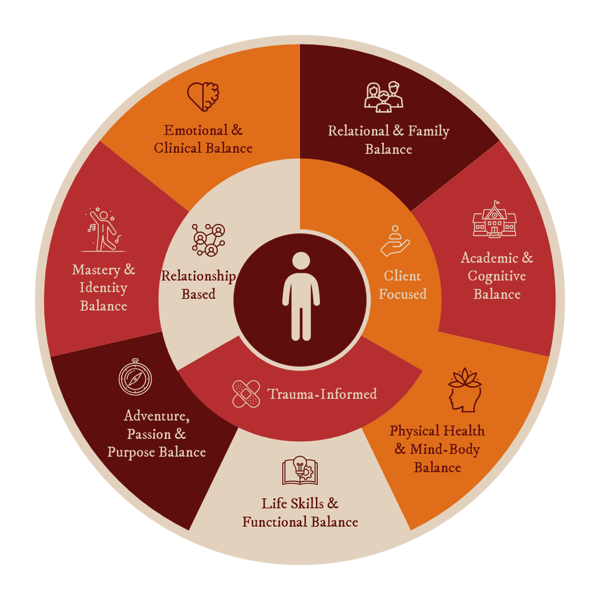
That's the thinking behind the In Balance Behavioral Health Model, the clinical framework that guides treatment across all of our programs. It's relational, client-first, and trauma-informed. It treats the entire young man, not just his diagnosis, his behavior, or his worst day.
A Different Starting Point
Most treatment models start with a list of symptoms to manage. Ours starts with a person.
We believe young people heal best when they feel safe, understood, supported, and challenged in the right ways, in that order. So before we ask a student to change his behavior, we work to understand what that behavior has been protecting him from. Before we ask a family to rebuild trust, we help them understand the patterns that broke it. Before we ask a young man to believe in himself again, we give him real opportunities to prove to himself that he can.
The goal was never just to stop the drinking, the drugs, the shutdown, or the shame spiral. The goal is a young man who is healthier, more confident, more connected, and ready for what comes next.
Three Foundational Commitments
Relational
The therapeutic relationship comes first. Before a young man can fully engage in treatment, he needs to experience trust, safety, respect, and real connection, with his therapist, his peers, and his family. Nothing else works without this.
Client-First
A student is never reduced to a diagnosis, a relapse history, a list of behaviors, or a family's worst fears about him. Treatment starts with the whole person: his story, his strengths, his trauma, his resistance, and his potential.
Trauma-Informed
Most of the behaviors that bring a young man to Align are rooted in pain, fear, shame, or disconnection, even when they look like defiance or apathy on the surface. We're not interested in compliance for its own sake. We're working toward regulation, insight, accountability, and real growth.
Seven Domains of Balance
The In Balance Behavioral Health Model is built around seven interconnected domains. Every piece of a student's treatment, clinical work, family therapy, academics, wellness, daily life, adventure, and identity, is organized around helping him find balance in each one.
Clinical Balance
Individual and group therapy, addiction treatment, mental health care, trauma-informed clinical work, and relapse prevention. This domain helps a young man understand himself, regulate his emotions, and build a healthier internal world.
Family Balance
Family systems therapy, parent coaching, and the intentional work of repairing trust. This domain helps families move from conflict and disconnection toward honesty and secure connection.
Academic Balance
Academic support, credit recovery, and rebuilding a student's confidence as a learner. Academic failure often becomes part of how a struggling teen sees himself, I'm lazy, I'm behind, I already blew it. We treat school as part of the clinical work because restoring academic confidence restores identity.
Mind-Body Balance
Fitness, nutrition, sleep, nervous system regulation, and mindfulness. Mental health and physical health are deeply connected, and at Align, wellness is part of the treatment model.
Life Skills Balance
Daily routines, responsibility, time management, and the kind of practical follow-through that doesn't always show up in a therapy session. A young man can learn to talk about his feelings and still struggle to function in daily life. This domain makes sure both things are happening at once.
Purpose Balance
Adventure, hobbies, sports, art, horsemanship, and healthy risk-taking. Sobriety can't just mean the absence of everything that used to feel exciting. Young men need to rediscover who they are without substances, chaos, or old identities, and that takes authentic experiences, not just insight.
Mastery Balance
Confidence, competence, leadership, and the repeated experience of earned success. This is the capstone of the model. Addiction and mental health struggles damage identity, and many young men arrive believing they're failures, disappointments, or burdens. Mastery is how that belief gets rewritten, not through being told it isn't true, but by proving it isn't.

How the Model Moves: Stabilize, Heal, Reconnect, Build, Launch
Balance isn't found all at once. It's built in stages, and our long-term model reflects that.
Stabilize.
The first work is safety, structure, and getting a young man's nervous system, behavior, and daily life regulated and onto solid ground.
Heal.
With stability established, deeper clinical work begins: processing trauma, understanding patterns, and building real emotional insight.
Reconnect.
A student starts repairing what struggle has damaged, his relationship with his family, with school, with himself.
Build.
Insight becomes practice. This is where life skills, academic momentum, and mastery experiences accumulate into real, demonstrated change.
Launch.
A young man transitions forward, whether that's home, to our Pivot Transitional Living program, or to the next chapter of his life, carrying tools and identity that hold up outside of treatment.
A Model Built for Real Life
The In Balance Behavioral Health Model isn't a curriculum to complete or a checklist to clear. It's a way of seeing a young man clearly, all the parts of him, and giving every one of those parts a real chance to heal.
This is the framework behind everything else on this site: our clinical care, our academics, our family programming, our equine and adventure work, our apprenticeships. None of it stands alone. All of it is in service of the same goal, a young man who leaves not just sober or stabilized, but balanced.